How to Convert CGPA to GPA The terms CGPA (Cumulative Grade Point Average) and GPA (Grade Point Average) are central to understanding your academic performance. However, confusion often arises when you need to convert your overall CGPA to a standard GPA, especially when applying to universities or for jobs in different countries, like the United States, which primarily uses a 4.0 scale.
This guide will demystify the process, explain why there’s no single perfect method, and provide you with the most common and accepted conversion techniques.
Table of Contents
First, A Crucial Disclaimer: There is No Universal Converter
Before we begin, it is vital to understand this: There is no official, one-size-fits-all mathematical formula to convert a CGPA to a GPA.
Why?
- Grading Scales Vary: Different universities and countries use different scales. Your CGPA might be on a 4.0, 5.0, 7.0, or 10.0 scale.
- Grading Rigor Varies: An 8.5/10 at one university might represent the same level of achievement as a 3.7/4.0 at another, but there’s no exact science to this comparison.
Therefore, the goal of conversion is to find the most accurate and fair estimate that institutions will recognize.
Step 1: Identify Your University’s Grading Scale
The first step is to know what scale your CGPA is based on. Check your official transcript or your university’s academic handbook. The most common scales are:
- 4.0 Scale (Common in the US, Canada)
- 10.0 Scale (Common in India, the Middle East)
- Percentage Scale (Often used alongside other scales)
Your conversion method will depend on your starting point.
Common Conversion Methods
Here are the most widely used methods for conversion. Always start with Method 1 if it’s available.
Method 1: The Official University Conversion Method (Recommended)
This is the most accurate and preferred method. Many universities, especially those operating on a 10-point system, provide an official equivalence table or formula on their website, in the academic handbook, or on the back of the transcript.
What to look for:
- A table that shows the CGPA range and its corresponding GPA on a 4.0 scale.
- A direct formula (e.g.,
GPA = (CGPA / Max_CGPA) * 4).
Example: Your university states that a CGPA of 8.0-8.9 on a 10-point scale is equivalent to a 3.5-3.9 on a 4.0 scale. If your CGPA is 8.5, you would report your GPA as ~3.7.
Always use this official method if it exists. It holds the most weight with admissions committees.
Method 2: The Standard 4.0 Scale Conversion (Common for 10-point Scales)
If your university does not provide an official conversion, this is the most commonly accepted approximation for converting a 10-point CGPA to a 4.0 GPA.
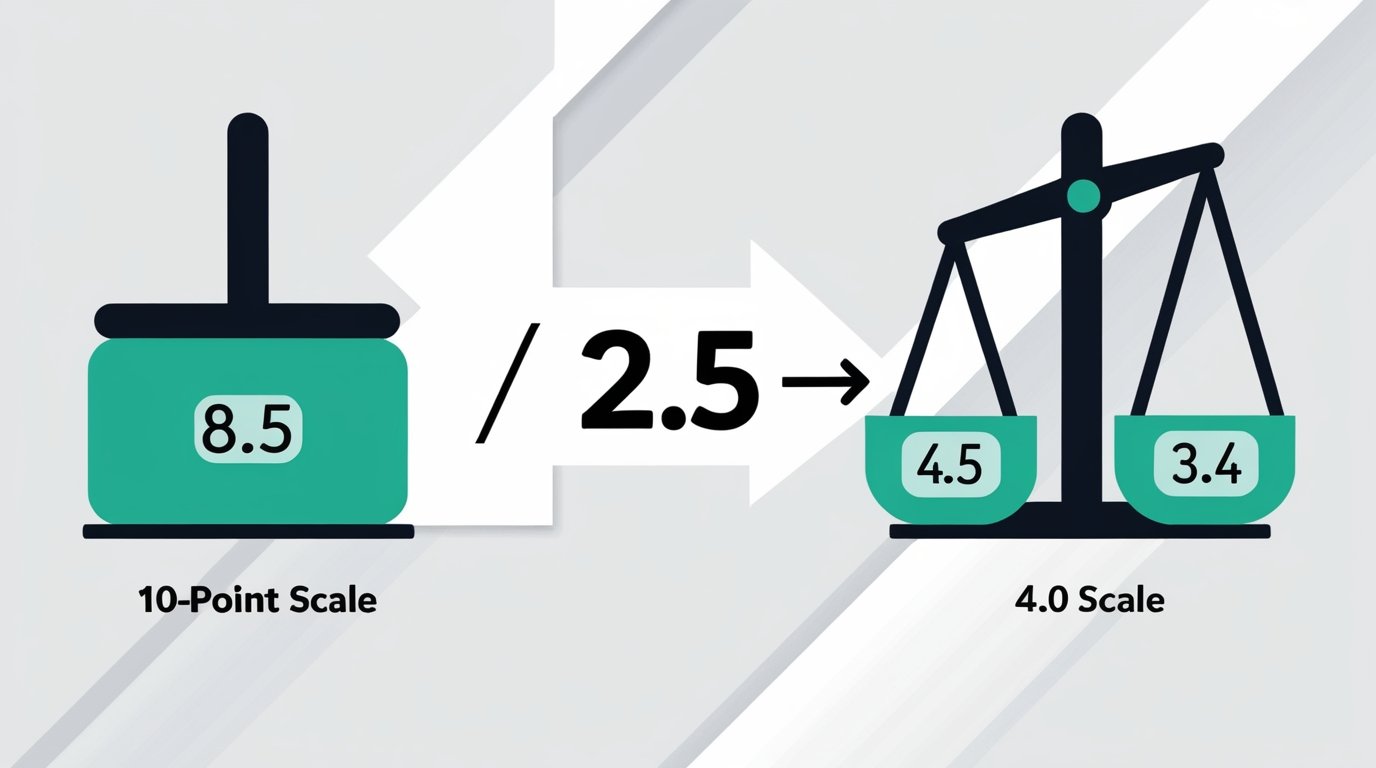
The Simple Formula:GPA = (CGPA / 10) * 4
Or, more simply: Divide your CGPA by 2.5.
Let’s calculate with an example:
- Your CGPA is 8.6 on a 10-point scale.
- Calculation: (8.6 / 10) * 4 = 3.44
- Or, 8.6 / 2.5 = 3.44
Therefore, an 8.6 CGPA is approximately a 3.44 GPA on a 4.0 scale.
Method 3: The 4.0 Conversion Chart (General Equivalence)
This chart provides a general guideline for estimating your GPA based on your CGPA. Remember, this is an estimate.
| CGPA (10-point scale) | Approx. GPA (4.0 scale) | Typical Letter Grade |
|---|---|---|
| 9.5 – 10.0 | 4.0 | A+ |
| 9.0 – 9.4 | 3.9 – 4.0 | A |
| 8.5 – 8.9 | 3.7 – 3.9 | A- / B+ |
| 8.0 – 8.4 | 3.5 – 3.7 | B+ |
| 7.5 – 7.9 | 3.3 – 3.5 | B |
| 7.0 – 7.4 | 3.0 – 3.3 | B- |
| 6.5 – 6.9 | 2.7 – 3.0 | C+ |
| 6.0 – 6.4 | 2.5 – 2.7 | C |
Method 4: The WES iGPA Calculator (For US/Canada Applications)
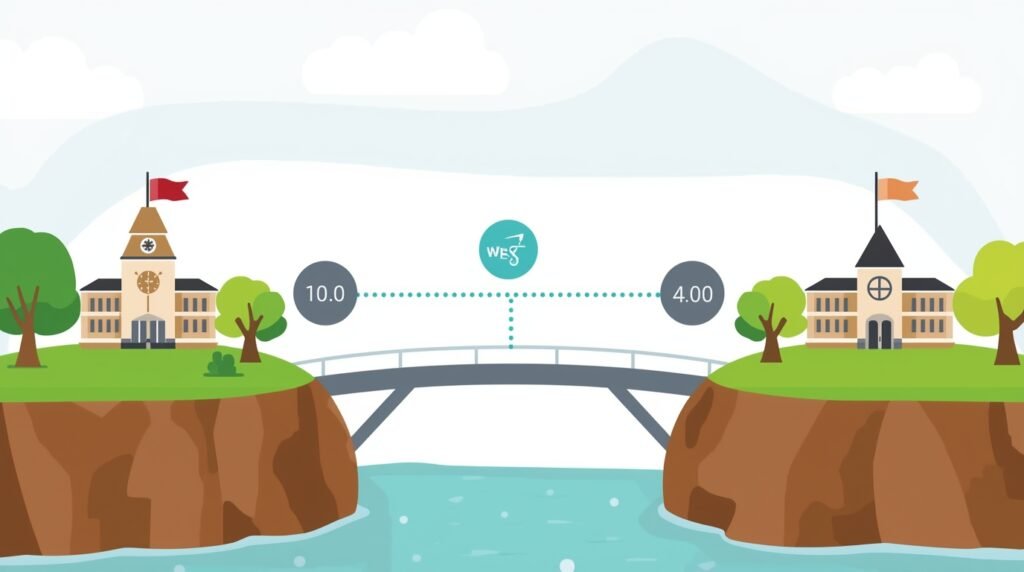
For applications to North American institutions, using a third-party credential evaluation service is highly recommended. The most trusted one is World Education Services (WES).
- What they do: WES analysts understand the grading systems of thousands of institutions worldwide. They don’t just apply a formula; they provide an evaluated equivalence based on their expertise.
- How to use it: WES offers a free online tool called the iGPA Calculator. You input your grades and credits for each course, and it provides an estimated GPA on a 4.0 scale. This is more accurate than a simple formula because it considers the weight of each individual course.
Step-by-Step Guide for a Practical Conversion
Let’s walk through the process with a hypothetical student, Anya.
- Anya’s Situation: She studied in India and has a CGPA of 8.2 on a 10-point scale. She is applying for a Master’s program in the USA, which requires her to list her GPA on a 4.0 scale.
- Step 1: Check for an Official Method.
- Anya checks her university’s website and finds no official conversion table.
- Step 2: Apply the Standard Conversion Formula.
- She uses the formula:
GPA = (CGPA / 10) * 4 GPA = (8.2 / 10) * 4 = 0.82 * 4 = 3.28
- She uses the formula:
- Step 3: Cross-reference with the Conversion Chart.
- According to the chart, an 8.2 CGPA falls in the 8.0-8.4 range, which approximates to a 3.5 – 3.7 GPA. This is a slightly higher estimate than the formula.
- Step 4: Use the WES iGPA Calculator (Recommended).
- Anya goes to the WES website and uses their free tool. She enters her individual course grades and credits.
- The WES tool calculates a more nuanced GPA of 3.45.
- Step 5: Report the GPA.
- Anya decides to use the WES evaluation of 3.45 as it is the most credible. On her applications, she can list her GPA as 3.45/4.0. If asked, she can explain it was calculated using the WES iGPA tool.
Important Tips and Best Practices
- Be Truthful: Never inflate your GPA. If an admissions office asks for an original transcript (which they almost always do), any discrepancy can seriously harm your application.
- Don’t Round Up aggressively: It’s acceptable to round to two decimal places (e.g., 3.28 becomes 3.28, not 3.3). Only round up if the third decimal is 5 or higher (e.g., 3.285 can be rounded to 3.29).
- Context is Key: On your resume or application, you can present your GPA clearly to avoid confusion.
- Example: “CGPA: 8.2/10.0 (Equivalent to 3.45/4.0 as per WES evaluation)”
- When in Doubt, Ask: If you are unsure, directly contact the admissions office of the institution you are applying to. Ask them what conversion method they prefer applicants to use.
Conclusion
Converting your CGPA to a GPA is less about finding a perfect mathematical equation and more about using the most credible and recognized estimation method. Always prioritize your university’s official conversion guide. If that doesn’t exist, using a reputable service like WES or the standard formula (CGPA / 2.5) will provide you with a fair and acceptable estimate for your applications.
By following this guide, you can confidently present your academic achievements in a format that is recognized and respected by institutions worldwide.
FAQs: Converting CGPA to GPA
Q1: Why is there no single universal conversion formula?
A: The main reason is the lack of standardization in grading systems across global universities. A grade of “B” or a CGPA of 8.0 can represent different levels of achievement depending on the institution’s grading rigor, class difficulty, and grading curves. Therefore, a simple mathematical formula cannot perfectly capture these nuances, which is why official conversions and credential evaluations are preferred.
Q2: My university doesn’t provide an official conversion. What is the most accepted method?
A: For a 10-point CGPA system, the most widely accepted and simplest approximation is to divide your CGPA by 2.5 to get your GPA on a 4.0 scale.
- Example: 8.5 CGPA / 2.5 = 3.4 GPA.
This method is generally understood by admissions committees as a reasonable estimate.
Q3: What is a credential evaluation service (like WES), and do I need to use one?
A: Credential evaluation services (e.g., World Education Services – WES, Educational Credential Evaluators – ECE) are third-party organizations that provide official equivalency reports for international academic credentials.
- Do you need it? It is often required for official university applications in the U.S. and Canada. They don’t just convert your GPA; they verify your transcripts are authentic and provide a standardized evaluation that admissions officers trust implicitly. For informal purposes (like a resume), it may not be necessary, but for applications, it is highly recommended if the university requires it.
Q4: Is it okay to round my converted GPA?
A: Use caution. It is generally acceptable to round to two decimal places for clarity (e.g., 3.444 becomes 3.44). You should only round up if the third decimal is 5 or higher (e.g., 3.445 can be rounded to 3.45). Never round a 3.49 to a 3.5, as this misrepresents your score. The safest practice is to use the exact figure provided by a conversion formula or evaluation service.
Q5: The conversion seems unfair. My 8.5/10 is a top score at my university, but it converts to only a 3.4/4.0. What should I do?
A: This is a common concern. You can provide context to ensure admissions committees understand your achievement:
- Class Rank/Percentile: If your university provides it, stating you were in the “top 10% of your class” is a powerful way to show your standing relative to your peers.
- Use a Statement: On your application or resume, you can write: “CGPA: 8.5/10 (University First-Class Honors, equivalent to a 3.7-4.0 GPA at my institution).”
- Trust the Process: Admissions officers are experienced in evaluating international credentials and are often familiar with the grading schemes of universities worldwide. They will consider your score within the context of your specific institution.
Q6: Should I convert my GPA myself on my resume and application?
A: For your resume, it is acceptable to provide a converted GPA using a standard method (like dividing by 2.5 for a 10-point scale). However, you must always:
- Be Transparent: Clearly state the original scale and the converted scale (e.g., “CGPA: 8.2/10 (approx. 3.3/4.0)”).
- Provide the Original: Be prepared to provide your official transcripts, which will show the original CGPA.
For formal university applications, always use the conversion method they request or the one provided by a credential evaluation service.
Q7: How do I convert a GPA from a 4.0 scale to a 10-point scale?
A: The process is simply the reverse. Multiply your 4.0-scale GPA by 2.5 to get an approximate value on a 10-point scale.
- Example: A 3.6 GPA * 2.5 = 9.0 CGPA.
This can be useful for understanding how your grades might translate to a different system.
Q8: My university uses a percentage system, not a CGPA. How do I convert that?
A: Converting a percentage is also not standardized. A common rough estimate is:
- GPA = (Percentage / 20) – 1 …or…
- % Range -> GPA:
- 90-100% = 4.0
- 80-89% = 3.0 – 3.9
- 70-79% = 2.0 – 2.9
- 60-69% = 1.0 – 1.9
- Below 60% = 0.0
The best method is to find an official conversion from your university or use the WES iGPA calculator, which allows you to input percentage grades.