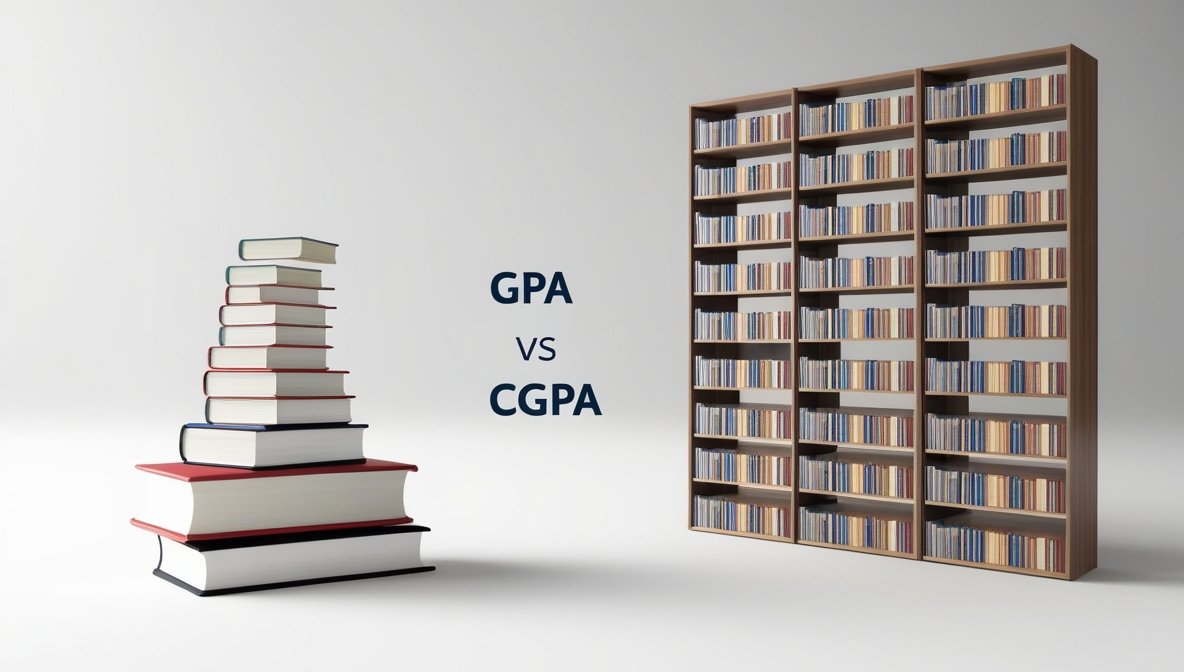
GPA vs CGPA: Which matters more? If you’re a student navigating the world of academics, you’ve undoubtedly encountered the terms GPA and CGPA. They are the universal metrics of your academic performance, the numbers that can feel like they define your entire educational journey. But what exactly is the difference between them? And more importantly, which one carries more weight when it matters most?
Let’s break it down in simple, clear terms.
Table of Contents
The Basic Definitions – What Are They?
First, we need to understand what each acronym stands for.
GPA (Grade Point Average)
Think of your GPA as a semesterly or term-wise report card. It is a numerical representation of your academic performance over a specific, short period, usually a single semester or term.
- How it’s calculated: Each of your course grades for that semester is converted to a grade point (e.g., A = 4.0, B = 3.0, etc.). These points are then averaged, often weighted by the credit hours of each course.
- The Analogy: Your GPA is like your batting average in a single baseball game. It tells you how well you performed in that specific game.
CGPA (Cumulative Grade Point Average)
Your CGPA is the big picture. It is the cumulative average of all your GPAs from every semester or term you have completed in your entire academic program up to the current point.
- How it’s calculated: It’s the sum of all your grade points earned in all your courses, divided by the total number of credit hours you’ve attempted. It’s a running tally that updates every semester.
- The Analogy: Your CGPA is your career batting average. It tells you your overall performance across every game you’ve ever played.
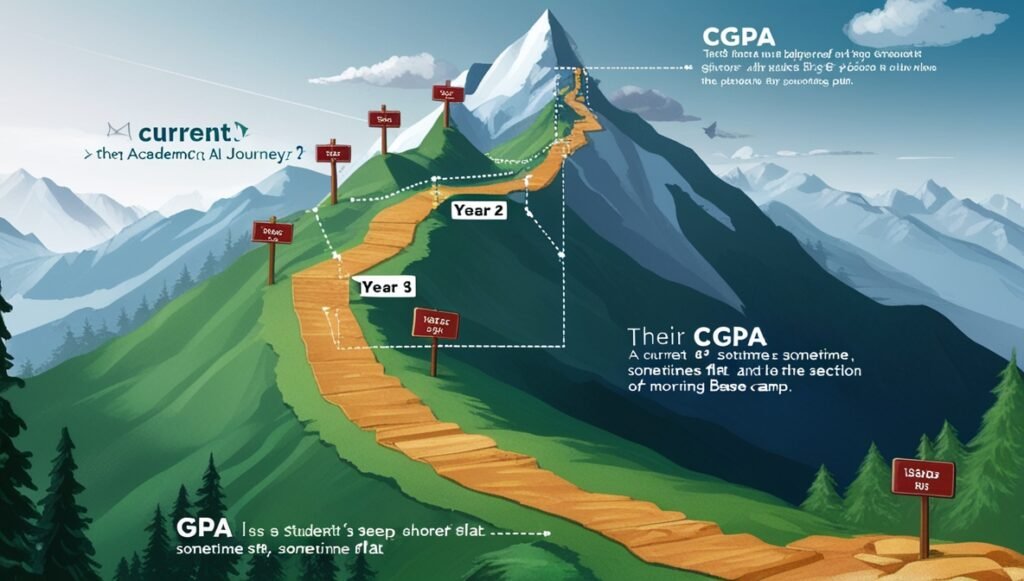
Key Differences at a Glance
This table summarizes the core distinctions:
| Feature | GPA (Grade Point Average) | CGPA (Cumulative Grade Point Average) |
|---|---|---|
| Scope | Short-term (One semester/term) | Long-term (Entire academic career) |
| Timeframe | Specific and limited | Cumulative and ongoing |
| Purpose | Measures performance in a specific set of courses | Measures overall academic performance |
| Fluidity | Changes every semester | Changes every semester, but more gradually |
| Represents | How you did in a particular term under specific circumstances | Your consistency and dedication over the years |
The Million-Dollar Question: Which One Matters More?
The truth is, both matter, but for different reasons and at different stages. It’s not about choosing one over the other; it’s about understanding their unique roles.
The Short Answer: Your CGPA is almost always the “official” number that carries more weight in final decisions. It’s the number on your final transcript and degree.
The Long Answer: Context is everything. Let’s look at specific scenarios.
1. For Your First Job or Internship (Just After Graduation)
- CGPA is King: When you’re a fresh graduate with limited work experience, recruiters use your CGPA as a quick, standardized filter to assess your work ethic, consistency, and ability to learn. A strong CGPA can get your foot in the door. Many large companies have strict CGPA cut-offs (e.g., “Must have a 3.0 CGPA or higher to apply”).
- GPA’s Role: If you had a rocky start but showed massive improvement in your final years, you can mention this in an interview. For example, “My CGPA is a 3.0, but I earned a 3.8 GPA in my last two semesters as I mastered my field of study.” This tells a powerful story of growth.
2. For Applying to Graduate School (Masters, PhD)
- CGPA is Crucial: Admissions committees for graduate programs heavily prioritize your CGPA. It demonstrates your long-term ability to handle rigorous academic work, which is essential for success in a Master’s or PhD program. A high CGPA is non-negotiable for most top-tier programs.
- GPA’s Role: Your transcript will show your semester-wise GPAs. A strong upward trend in your GPA (e.g., low scores in first year, excellent scores in final years) can be a positive factor, showing you overcame initial challenges. Conversely, a downward trend can raise red flags.
3. For Scholarships and Financial Aid
- CGPA is Usually the Benchmark: Most scholarships require you to maintain a minimum CGPA to remain eligible. They are rewarding sustained excellence, not a one-off good semester.
- GPA’s Role: Some scholarships might be awarded based on performance in a specific year or semester, making your GPA for that term critically important.
4. During Your Studies (The Journey)
- GPA is Your Early Warning System: Your semester GPA is your best friend during your degree. It gives you immediate feedback. A sudden drop in your GPA can signal that you’re struggling with the course load, a particular subject, or perhaps external factors affecting your studies. It allows you to course-correct before it severely impacts your CGPA.
- CGPA is Your Compass: Your CGPA shows you where you stand overall. It helps you understand what you need to achieve in your remaining semesters to reach your final goal (e.g., “I need a 3.5 GPA each semester to graduate with a 3.7 CGPA”).
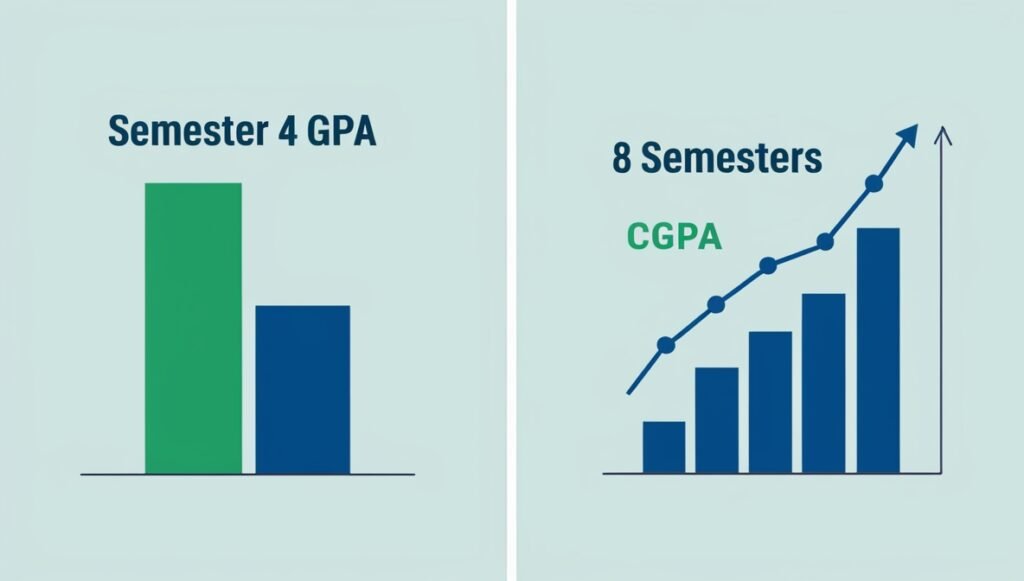
The Strategy – How to Think About Both
Instead of seeing them as rivals, see them as interconnected tools.
- Protect Your CGPA from Day One: Your CGPA is hardest to change in your final years. A low GPA in your first semester pulls your CGPA down, and you’ll spend the next three years trying to lift it back up. Start strong.
- Use Your GPA to Build Your CGPA: Every semester is an opportunity to improve your CGPA. A high GPA doesn’t just look good on its own; it actively boosts your cumulative score.
- An Upward Trend is Golden: Consistently improving GPAs tell a story of adaptability, resilience, and growth. This narrative can be just as compelling as a consistently high CGPA in many situations.
- Don’t Panic Over One Bad Semester: Everyone can have an off term. While it will affect your CGPA, one low GPA is not the end of the world. Recover strongly in the next semester to show it was an anomaly.
Final Verdict
Think of it this way:
- Your GPA is the individual chapter of a book.
- Your CGPA is the entire story.
While people will often judge the book by its overall plot (CGPA), a truly compelling story has strong, well-written chapters (GPAs) throughout. A fantastic ending can make up for a slow start, and a strong beginning sets the tone for everything that follows.
So, which matters more? For your permanent record, your diploma, and that first job interview—your CGPA is the headline act. But you cannot achieve a great CGPA without consistently focusing on earning solid GPAs every single semester. They are two sides of the same very important coin. Focus on doing your best in the present semester (GPA), and your future cumulative score (CGPA) will take care of itself.
FAQs: GPA vs. CGPA
Q1: Can a high GPA in my final year make up for a low CGPA?
A: To some extent, yes. A significant upward trend in your GPA, especially in your final years and in key major-related courses, can be very persuasive. You can highlight this improvement in job interviews or graduate school applications to show growth, mastery of the subject, and renewed focus. However, it may not completely override a very low CGPA for automated filters that have strict cut-off scores.
Q2: How is CGPA actually calculated from my GPAs?
A: Your CGPA is not simply an average of your semester GPAs. It is a weighted average based on the total credit hours you’ve attempted.
- Example: Imagine:
- Semester 1 (15 credits): GPA of 3.0
- Semester 2 (18 credits): GPA of 4.0
- The calculation is:
(Total Grade Points Earned) / (Total Credits Attempted) (3.0 * 15) + (4.0 * 18) = 45 + 72 = 117 Total Grade Points15 + 18 = 33 Total Credits- CGPA = 117 / 33 = 3.54
Q3: Do employers look at my individual semester GPAs or just the final CGPA?
A: Most employers, especially for entry-level roles, will primarily look at your final CGPA as a quick screening tool. However, if your transcript is part of the application, a recruiter might notice a positive upward trend or particularly high grades in relevant courses. They are more likely to delve into individual courses and semesters during an interview to understand your strengths.
Q4: Is a 3.5 CGPA on a 4.0 scale considered good?
A: Generally, yes, a 3.5 is very good. It places you in the B+/A- range and is competitive for many jobs and graduate programs. However, “good” is relative. Top-tier companies or elite graduate schools (like Ivy Leagues) might have pools of applicants with near-perfect 3.8+ CGPAs. Always research the typical requirements for your specific field and target institutions.
Q5: What’s more important for my career after my first job?
A: After you gain 2-3 years of relevant work experience, your professional experience, skills, and accomplishments will almost always outweigh your CGPA. Your career history becomes the primary measure of your potential. While some highly specialized fields (e.g., academia, research) may still consider academic records, for most industries, your degree becomes a checkbox requirement, and the focus shifts entirely to your work portfolio.
Q6: I’m confused by different grading scales. How do I convert my percentage or CGPA to a 4.0 GPA?
A: This is a common challenge, especially for international students. Conversion is not always perfect or standardized. The best approach is:
- Check with the Institution: The university or employer you are applying to may have its own official conversion chart. Always use this if available.
- Use a General Guide: If no official chart exists, a common (but not universal) conversion is:
- 90-100% = A = 4.0
- 80-89% = B = 3.0
- 70-79% = C = 2.0
- 60-69% = D = 1.0
- Below 60% = F = 0.0
- Use a Credential Evaluation Service: For important applications (like for a visa or foreign university), consider using a professional evaluation service like WES (World Education Services) for an official conversion.
Q7: If I retake a class I failed, how does it affect my GPA and CGPA?
A: This depends entirely on your university’s policy.
- Replacement: Many schools allow you to replace the old, failing grade with the new grade in your GPA calculation. The F remains on your transcript but is excluded from the GPA calculation.
- Averaging: Other institutions will average the two grades together for your GPA.
- CGPA Impact: In either case, retaking a class and earning a better grade will almost always improve your CGPA, as you are adding more grade points for the same course credit.
Q8: Should I include both my GPA and CGPA on my resume?
A: It depends on your situation:
- If both are strong: You can list both (e.g., “CGPA: 3.7/4.0, with a Final Year GPA: 3.9/4.0”).
- If your CGPA is low but you have an upward trend: You could list your “Major GPA” (just your core subject grades) or your “GPA for Final 2 Years” if it is significantly higher and more relevant.
- If your CGPA is strong: Just listing your CGPA is perfectly sufficient.
- General Rule: Always be prepared to provide your official transcript if asked.