What is SGPA and how to calculate it? If you’re navigating the world of higher education, especially in a system that follows a credit-based structure, you’ve likely encountered a flurry of acronyms: GPA, CGPA, and SGPA. While they all measure academic performance, understanding each one individually is key to tracking your progress.
This article focuses on SGPA—what it is, why it matters, and exactly how you can calculate it yourself.
What Exactly is SGPA?
SGPA stands for Semester Grade Point Average. As the name suggests, it is a measure of your academic performance in a single semester.
Think of it like a quarterly report in a business. It doesn’t tell you the company’s entire history, but it gives a very clear, focused snapshot of how it performed in that specific three-month period.
- It’s a number: Typically on a scale of 0 to 10 (common in countries like India) or 0 to 4 (common in the US and Canada).
- It’s specific: It only considers the courses you took in one particular semester.
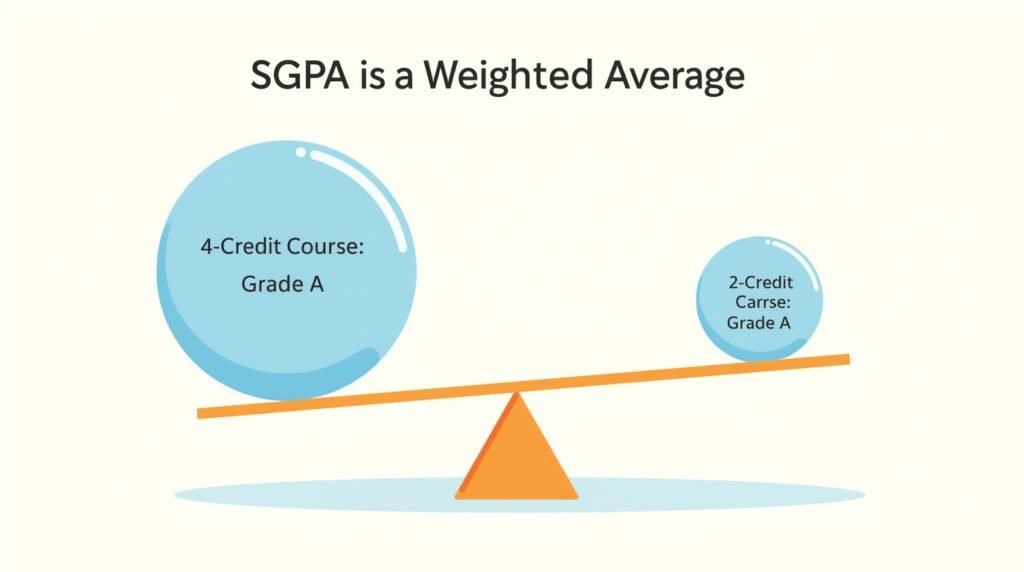
- It’s weighted: It considers not just your grades, but also the “weight” or importance of each course, which is represented by its credit hours.
In short: Your SGPA is the weighted average of the grade points you earned in all the courses you took during one semester.

Why is SGPA Important?
You might wonder, “If my final degree depends on my overall CGPA, why should I care about my SGPA?” Here’s why it’s crucial:
- Immediate Feedback: Your SGPA is your academic health check-up at the end of each semester. A high SGPA tells you your study methods are working. A lower-than-expected SGPA is an early warning sign that you might need to adjust your strategies for the next term.
- Building Block for CGPA: Your CGPA (Cumulative Grade Point Average) is not calculated from scratch each time. It is literally built by averaging all your SGPAs (with credit weightings). Therefore, every high SGPA you earn actively pulls your overall CGPA up.
- Scholarships and Honors: Many universities award semester-based scholarships, dean’s list honors, or other recognitions based solely on your SGPA for that term.
- Placement Opportunities: For internships or job applications that happen during your degree, companies often ask for your latest SGPA or the SGPA of the previous semesters, as your final CGPA isn’t available yet.
How to Calculate Your SGPA: A Step-by-Step Guide
Calculating your SGPA is a straightforward process once you understand the components. You just need your semester’s grade sheet.
The Key Components:
- Course Credits (Credit Hours): Every course you take is assigned a certain number of credits (e.g., 2, 3, 4). This number represents the weight or volume of the course. A 4-credit core subject is considered more “important” than a 1-credit seminar.
- Grade Points: Each letter grade you receive (e.g., A, B, C) corresponds to a specific number on a scale. The most common 10-point scale is:
- A+ / O (Outstanding) = 10
- A (Excellent) = 9
- B+ (Very Good) = 8
- B (Good) = 7
- C+ (Average) = 6
- C (Below Average) = 5
- F (Fail) = 0
- (Note: Scales can vary slightly by university. Always check your institution’s guidelines.)
The SGPA Formula
The formula for calculating SGPA is:
SGPA = Σ (Course Credits × Grade Point) / Σ (Course Credits)
- Σ (Sigma) means “the sum of.”
- So, you’re adding up the product of (Credits × Grade Point) for every course, and then dividing that total by the sum of all the credits you attempted that semester.
Walkthrough with an Example
Let’s say you had the following results in your first semester:
| Course Name | Credits | Grade Received | Grade Point |
|---|---|---|---|
| Mathematics | 4 | A | 9 |
| Physics | 3 | B+ | 8 |
| Programming | 3 | A+ | 10 |
| English | 2 | B | 7 |
| Environmental Science | 1 | C+ | 6 |
Step 1: Calculate the “Credit Points” for each course.
This is the product of (Course Credits × Grade Point).
- Mathematics: 4 Credits × 9 Grade Point = 36
- Physics: 3 Credits × 8 Grade Point = 24
- Programming: 3 Credits × 10 Grade Point = 30
- English: 2 Credits × 7 Grade Point = 14
- Environmental Science: 1 Credit × 6 Grade Point = 6
Step 2: Find the total sum of these Credit Points.
Σ (Course Credits × Grade Point) = 36 + 24 + 30 + 14 + 6 = 110
Step 3: Find the total number of credits you attempted.
Σ (Course Credits) = 4 + 3 + 3 + 2 + 1 = 13
Step 4: Divide the total credit points by the total credits.
SGPA = 110 / 13 = 8.46
Congratulations! Your SGPA for the semester is 8.46 on a 10-point scale.
SGPA vs. GPA vs. CGPA: A Quick Recap
To avoid confusion, let’s quickly distinguish these terms:
| Term | Stands For | What It Measures | Scope |
|---|---|---|---|
| SGPA | Semester Grade Point Average | Performance in a single semester | Short-Term |
| GPA | Grade Point Average | Can mean SGPA or the average for a specific year or selection of courses. Often used interchangeably with SGPA. | Short-to-Medium Term |
| CGPA | Cumulative Grade Point Average | The overall average of all semesters combined in your entire program. | Long-Term |
Pro Tip: Your final degree certificate almost always mentions your CGPA. Your SGPA is the stepping stone to achieving that final, all-important number.
Final Thoughts
Understanding your SGPA empowers you to take control of your academic journey. It’s not just a number on a transcript; it’s a tool for self-assessment. By calculating it yourself each semester, you can set specific goals, identify subjects where you need more focus, and strategically work towards building a strong CGPA that will open doors to future opportunities.
Remember, consistency is key. One great SGPA can boost your morale, and one not-so-great one is a chance to learn and improve. Keep track, stay focused, and use the SGPA as your guide to academic success.
FAQs: Understanding Semester Grade Point Average (SGPA)
Q1: What does SGPA stand for?
A: SGPA stands for Semester Grade Point Average. It is a numerical measure (like a score) of a student’s academic performance in a single semester or term.
Q2: How is SGPA different from my overall percentage?
A: A percentage is a simple average of your marks in all subjects. SGPA is a weighted average. It considers the importance (credit hours) of each course. For example, a high grade in a 4-credit course will impact your SGPA more than the same grade in a 2-credit course. A percentage often does not make this distinction.
Q3: I failed a subject this semester. How will it affect my SGPA?
A: A failed grade (usually ‘F’ which corresponds to 0 grade points) will significantly lower your SGPA. Since you multiply the course’s credits by 0, it adds no points to your total credit points, but the credits are still added to your total attempted credits, dragging the average down. You will typically need to retake the course to replace the grade or clear a backlog.
Q4: Is a higher SGPA always better?
A: Generally, yes. A higher SGPA indicates stronger academic performance in that specific semester. It will boost your cumulative average (CGPA) and can make you eligible for semester-based scholarships and honors. However, consistency over multiple semesters is ultimately what builds a strong academic record.
Q5: My university uses a 10-point scale. What is considered a “good” SGPA?
A: This can be subjective and depends on your university’s grading culture and your personal goals. However, a general rule of thumb is:
- 8.5 and above: Excellent / First Class with Distinction
- 7.0 to 8.4: Very Good / First Class
- 6.0 to 6.9: Good / Second Class
Always check your university’s specific academic regulations for official classification.
Q6: How can I improve my SGPA in the next semester?
A: The most effective way is to focus on courses with higher credit weights. Earning a good grade in a 4-credit course will have a bigger positive impact on your SGPA than the same grade in a 2-credit course. Of course, you should aim to perform well in all your subjects.
Q7: Do all types of courses count towards my SGPA?
A: Typically, yes. All courses you are registered for in a semester—whether core subjects, electives, labs, or seminars—usually contribute to your total credits and are included in the SGPA calculation. A course marked as “Audit” or “Non-Credit” may be an exception.
Q8: How do I convert my SGPA to a percentage?
A: There is no universal formula, as grading scales vary. However, a common method used by many Indian universities is:
Percentage = (SGPA / 10) * 100
Example: An SGPA of 8.46 would be (8.46 / 10) * 100 = 84.6%.
Important: You must always use the conversion formula specified by your university, as some may use a different calculation (e.g., Percentage = (SGPA – 0.5) * 10).