

It is 11:30 PM on a Tuesday. Your eyes are burning from staring at your laptop screen,
and you are hovering your mouse over your university’s grading portal. You run the
numbers once. You run them twice. Your heart drops into your stomach.
Your cumulative average has slipped below a $3.0$, or maybe it just fell below the strict
merit threshold required by your financial aid package.
Suddenly, the scholarship you worked so hard to secure feels like it is slipping through
your fingers. Cue the immediate spiral of academic anxiety: Am I going to lose my
funding? How will I pay for next semester? Can I even fix this in time?
· First, take a deep breath. Stumbling over a brutal semester, dealing with a personal
crisis, or getting wrecked by a notoriously difficult “weed-out” class happens to the
absolute best of us. But here is the cold truth: panicking won’t fix your GPA—strategic
mathematics, policy leverage, and targeted habit shifts will.
· Whether you are fighting to protect a current grant or planning a legendary academic
comeback to qualify for new funding, this guide breaks down the exact blueprint for
grade recovery and scholarship preservation.
Part 1: Decoding Scholarship Cut-offs (Before
You Panic):
· Most students see a drop in their grades and assume their financial aid is instantly
gone. In reality, academic funding is governed by strict, specific bureaucratic
structures. Before you write a frantic email to your financial aid office, you need to
audit your scholarship’s precise evaluation criteria.
v The Standard Requirements Matrix: Understanding
SAP:
· Most merit-based scholarships and federal student aid packages require students to
maintain a baseline standard known as SAP (Satisfactory Academic Progress).
SAP relies on three distinct pillars, and missing just one can put your funding at risk:
Requirement
Metric What It Actually Measures Typical Merit
Cut-off
Cumulative
GPA
The weighted average of all grades
across your entire university history.
$3.00$ to
$3.50$ (Scale of
$4.0$)
Completion
Rate (Pace)
The percentage of total attempted credits
you actually pass without dropping.
67% to 75% of
classes
Credit
Minimums
The absolute number of credits you must
complete each academic year.
12 credits/semester
(Full-time status)
The Grace Period: Academic Probation vs. Immediate
Forfeiture:
· Here is a major piece of good news: very few scholarships pull your funding
instantly after one bad semester.
· Most institutional funding bodies implement an Academic Probation Semester. This
is a designated grace period where you retain your financial aid but are placed under
strict warning. You are given exactly one semester (or sometimes one full academic
year) to pull your cumulative GPA back over the official line.
🔍 Your Immediate Action Step:
Log into your student portal and pull up the original terms and conditions of your
scholarship. Look specifically for two phrases: “Evaluation Period” (Is it checked every
semester, or only once a year in May?) and “Probationary Policy.” Knowing your exact
timeline changes your strategy from blind panic to a calculated race against the clock.
Part 2: The Math of the Academic Comeback:
· You cannot fix a damaged GPA by simply “studying harder.” You have to treat your
transcript like a data optimization problem. To raise your average efficiently, you need
to understand how credit weights dictate your cumulative score.
vThe Law of Credit Hours:
· An ‘A’ in a 4-credit organic chemistry lecture or a heavy engineering module moves
your GPA twice as much as an ‘A’ in a 2-credit elective.
· If you are fighting to clear a strict cut-off, you cannot afford to spend equal time on
all classes. You must ruthlessly prioritize your highest-credit courses because they
wield the heaviest mathematical leverage over your cumulative GPA equation.
$$\text{Term GPA} = \frac{\sum (\text{Grade Points} \times \text{Course
Credits})}{\sum \text{Total Course Credits}}$$
The Strategic Formula: Predicting Your Required
Targets:
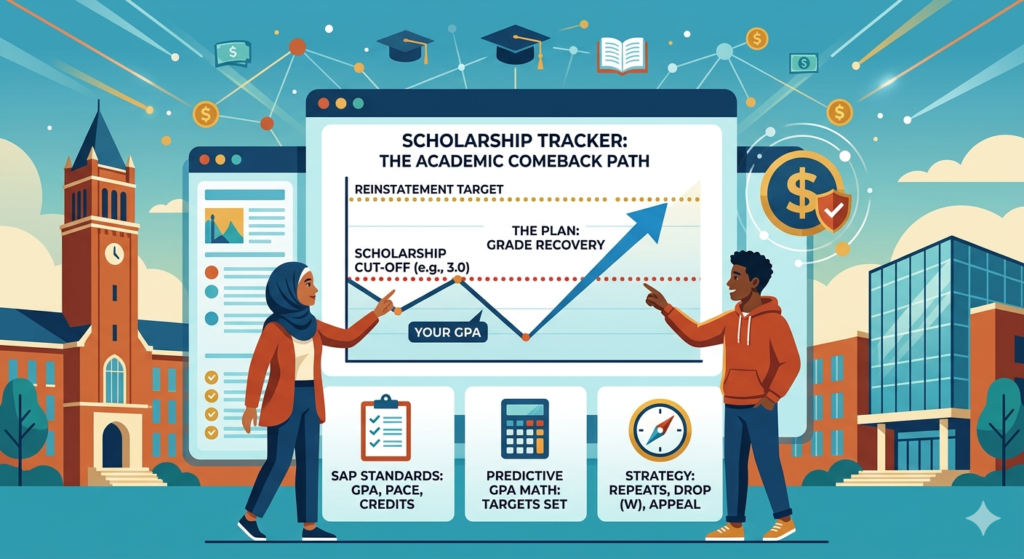
· Let’s look at a realistic scenario. Suppose you have completed 30 credits with a
current cumulative GPA of 2.70. Your scholarship requires a 3.00 by the end of next
semester, where you plan to take 15 credits.
· What exact average do you need to achieve next semester to save your funding? We
can calculate this using a targeted recovery formula:
$$\text{Required Term GPA} = \frac{(\text{Target GPA} \times \text{Total Final Credits})
- (\text{Current GPA} \times \text{Current Credits})}{\text{Upcoming Semester
Credits}}$$
Let’s plug your data points directly into the equation:
· Current Credits = $30$
· Current GPA = $2.70$
· Upcoming Credits = $15$
· Total Final Credits = $45$ ($30 + 15$)
· Target GPA = $3.00$
$$\text{Required Term GPA} = \frac{(3.00 \times 45) – (2.70 \times 30)}{15}$$
$$\text{Required Term GPA} = \frac{135 – 81}{15} = \frac{54}{15} = 3.60$$
The math shows that you need a 3.60 Term GPA across your next 15 credits to push
your cumulative average up to a $3.00$. This means your target is a clean mix of A’s
and B’s, with absolutely no room for C’s or D’s. Knowing this specific number gives you
an unambiguous goal to hit.
Part 3: Tactical Grade Recovery Execution:
· Now that you know your timeline and your target numbers, it’s time to execute. This
execution strategy is designed to maximize your grade yield while minimizing wasted
effort.
- Leverage Grade Forgiveness and Repeat Policies:
Ø This is the single fastest way to repair a broken GPA. Most universities have a “Course
Repeat” or “Grade Forgiveness” policy built into their registrar guidelines.
Ø If you retake a class that you completely failed or scored a ‘D’ in, many institutions will
completely overwrite the old grade with your new grade in your cumulative GPA
calculation (though the original attempt will still show as a historical record on your
transcript).
· The Power of Overwriting: If you replace a 3-credit ‘F’ ($0.0$) with an ‘A’ ($4.0$),
you instantly inject 12 massive grade points into your GPA calculation without
increasing your total credit denominator. It provides an upward spike that would
normally take three semesters of perfect grades to achieve through new classes
alone. - Triangulate the “Office Hours Leverage”:
· Professors do not just grade your paperwork; they grade you. If a professor sees a
student who sits in the back row, avoids eye contact, and never reaches out, they will
show zero flexibility when rounding a 79.4% up to an 80% (converting a B- to a B).
· By week two of the semester, show up to your professor’s office hours with two specific
questions about the upcoming syllabus or lecture material. Explicitly state your goals:
· “I had a rough performance last semester, and I am on a strict scholarship recovery
track. I want to ensure I am mastering this material completely. What common pitfalls
should I avoid on your midterms?”
· You have just transformed yourself from an anonymous name on a grading
spreadsheet into a dedicated, proactive human being. When final grades are close to
a borderline, this psychological shift matters immensely. - Implement the 80/20 Rule of High-Yield Studying:
Ø Stop rewriting your textbook notes using multi-colored highlighters. It feels like
productive work, but cognitively, it is passive and highly inefficient. Grade recovery
requires high-yield, science-backed study techniques:
· Active Recall: Close your textbook, flip over your laptop, and write down
everything you can remember on a blank piece of paper from sheer memory. Force
your brain to retrieve the information unprompted.
· Spaced Repetition: Use flashcard systems like Anki to review difficult concepts
1, 3, and 7 days after a lecture, preventing the “forgetting curve” from wiping out your
progress before finals week.
· The Reverse Blueprint: Acquire past exams from previous semesters
immediately. Do not use them to quiz yourself at the very end of your revision; look at
them first to see exactly how the professor structures questions so you can filter your
reading accordingly. - Protect Your Denominator (The Strategic Drop):
· If you get to the midpoint of the semester and realize you are failing a course despite
your absolute best efforts, look up your university’s Academic Withdrawal (W)
deadline.
· While dropping a class leaves a “W” on your transcript, a “W” carries zero weight in
your GPA calculation. It is infinitely better to take a “W” and protect your cumulative
average than to stubbornly drag an ‘F’ or a ‘D’ into your scholarship evaluation pool.
You can always catch up on the missed credits during a summer session.
How to Write a Scholarship Appeal Letter (If You
Fall Short)?

· If the evaluation date arrives and you missed your target cut-off by a fraction of a
point, do not despair. You still have one final card to play: the Financial Aid /
Scholarship Appeal Letter.
· Committees are run by real human beings who understand that life happens. If your
grades dropped due to documented extenuating circumstances—such as an illness,
mental health struggles, family emergencies, or sudden financial distress—you can
submit a formal appeal to have your aid reinstated.
When writing your appeal, follow this professional, humanized framework to
maximize your chances of approval:
Markdown
Subject: Formal Scholarship Reinstatement Appeal – [Your Name] – [Student ID] Dear
Scholarship Committee Members, I am writing to formally appeal the suspension of my
[Name of Scholarship] for the upcoming academic year. I am fully aware that my
cumulative GPA currently stands at [Your GPA], which falls just below the mandatory
[Required GPA] threshold. I take absolute accountability for this performance. During
the previous semester, I faced significant, unforeseen challenges, including [briefly state
the challenge: e.g., a severe medical diagnosis / a family crisis], which severely
impacted my ability to focus on my coursework during midterms. (Attach supporting
documentation like doctor’s notes if available). Rather than letting this define my
academic journey, I have taken proactive steps to ensure this never happens again.
Over the past few weeks, I have: – Met with my academic advisor to structure a
balanced course load. – Locked in weekly tutoring slots at the University Writing/Math
Center. – Established a rigorous study regimen to guarantee my progress. My
education is my absolute highest priority, and this scholarship is the engine that allows
me to pursue it. I respectfully request a probationary semester extension to prove that I
can bring my cumulative record back up to the university’s high standards. Thank you
for your time, consideration, and dedication to supporting student success. Sincerely,
[Your Name] [Contact Information]
Stop Guessing: Calculate Your Exact Recovery
Path:
· The biggest mistake you can make during an academic comeback is operating on
guesswork. You cannot guess your way out of a strict scholarship cut-off.
· If you want to map out your upcoming semester targets without dealing with painful
algebraic formulas, use our free tool at Simple CGPA Calculator.
You can input your current credit baseline, plug in your target scholarship
threshold, and experiment with different semester projections instantly. It
handles the weighted credit calculations automatically so you can focus 100% of
your energy where it belongs: crushing your classes, securing your funding, and
executing your comeback with total confidence!