What is CGPA? If you’re a student, especially at the university level, you’ve likely encountered the acronyms GPA and CGPA. While they are often used interchangeably in casual conversation, they represent two different, but closely related, measures of your academic performance.
Understanding what they are, how they’re calculated, and why they matter is crucial for tracking your progress and planning your academic future.
Table of Contents
The Basics: GPA vs. CGPA
Let’s break down the terminology first.
- GPA (Grade Point Average): This is your Grade Point Average for a single semester or term. It’s a snapshot of your academic performance over a short, specific period.
- CGPA (Cumulative Grade Point Average): This is your Cumulative Grade Point Average. It is the overall average of your grade points across all semesters and all courses you have taken so far in your academic program.
The simplest analogy: Think of your GPA as a single game’s score in a sports season. Your CGPA is your team’s overall win-loss record for the entire season so far.
How is it Calculated? A Step-by-Step Breakdown
The calculation might seem complicated, but it’s just a weighted average. Here’s how it works:
Step 1: Understand the Grade Point System
Every letter grade you receive corresponds to a numerical “grade point.” While scales can differ by country and institution, a common 10-point or 4-point scale is used.
Common 10-Point Scale (e.g., used in India):
- A+ / O (Outstanding): 10
- A (Excellent): 9
- B+ (Very Good): 8
- B (Good): 7
- C+ (Average): 6
- C (Below Average): 5
- F (Fail): 0
Common 4-Point Scale (e.g., used in the USA, Canada):
- A: 4.0
- B: 3.0
- C: 2.0
- D: 1.0
- F: 0.0
Step 2: Calculate “Credit Points” for Each Course
Courses aren’t all equal. A foundational class that meets for one hour a week is worth less than a core subject lab that meets for five hours. This weight is represented by Credit Hours (or simply Credits).
To find the “Credit Points” for a single course, you multiply the Grade Point you earned by the Credit Hours for that course.
Formula for one course:
Credit Points = Grade Point × Credit Hours
- Example: You took “Calculus I,” a 4-credit course, and scored an ‘A’ (which is a 9 on a 10-point scale).
- Your Credit Points for Calculus I = 9 × 4 = 36
Step 3: Calculate Your CGPA
After you do this for every course in a semester, you can calculate your Semester GPA.
Now, to find your CGPA, you do the same thing for ALL the courses you’ve ever taken in your degree.
The Formula:
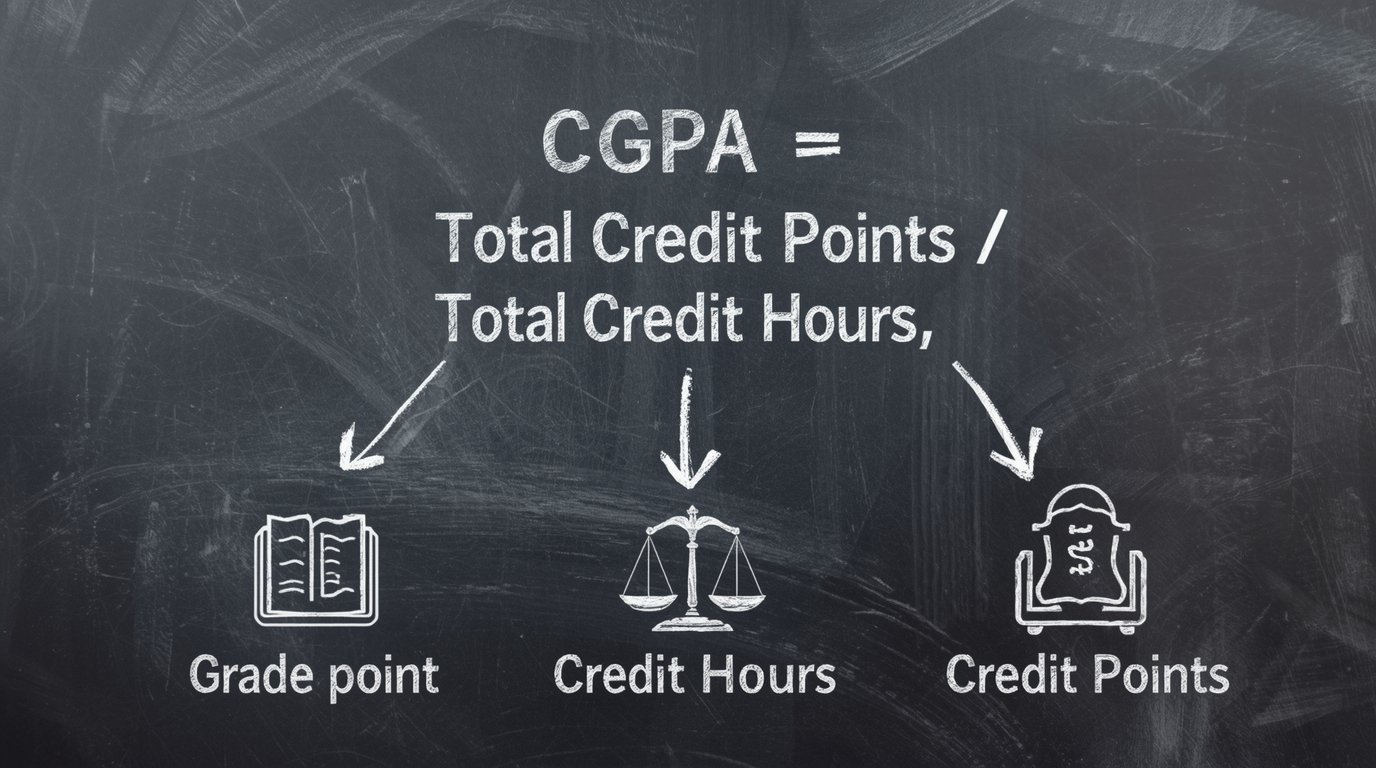
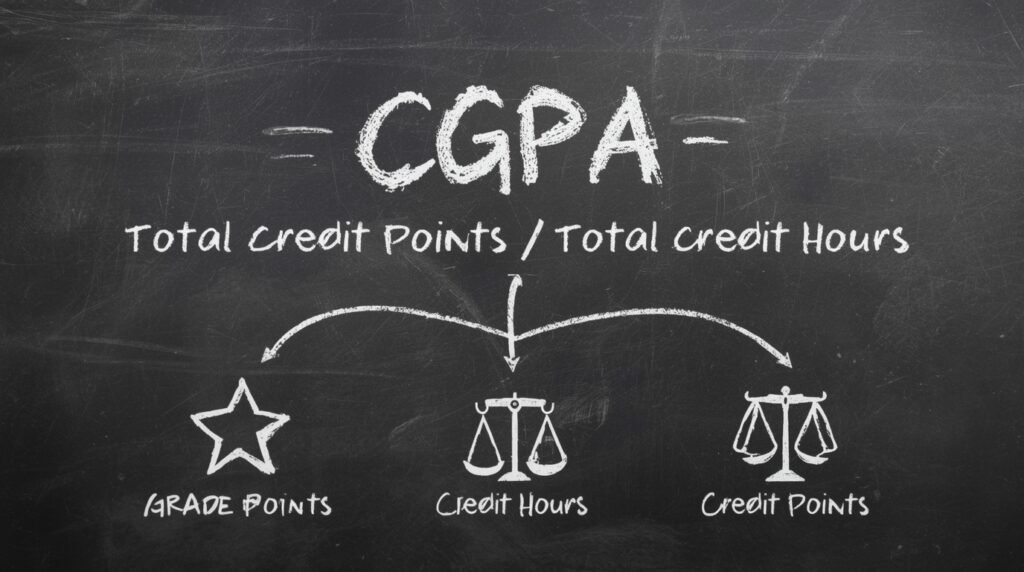
CGPA = Total Credit Points from ALL Semesters ÷ Total Credit Hours from ALL Semesters
A Detailed Example (Using a 10-Point Scale)
Let’s imagine a student’s first-year results:
Semester 1:
| Course | Credit Hours | Grade | Grade Point | Credit Points |
|---|---|---|---|---|
| Subject 1 | 4 | A | 9 | 9 × 4 = 36 |
| Subject 2 | 3 | B+ | 8 | 8 × 3 = 24 |
| Subject 3 | 2 | A+ | 10 | 10 × 2 = 20 |
| Semester 1 Totals: | 9 | 80 | ||
| Semester 1 GPA | *80 / 9 = 8.89* |
Semester 2:
| Course | Credit Hours | Grade | Grade Point | Credit Points |
|---|---|---|---|---|
| Subject 4 | 4 | B | 7 | 7 × 4 = 28 |
| Subject 5 | 3 | A | 9 | 9 × 3 = 27 |
| Subject 6 | 3 | O | 10 | 10 × 3 = 30 |
| Semester 2 Totals: | 10 | 85 | ||
| Semester 2 GPA | *85 / 10 = 8.5* |
Now, to calculate the CGPA after Year 1:
- Total Credit Points (All Semesters): 80 (Sem 1) + 85 (Sem 2) = 165
- Total Credit Hours (All Semesters): 9 (Sem 1) + 10 (Sem 2) = 19
- CGPA = 165 ÷ 19 = 8.68
This student’s Cumulative GPA after two semesters is 8.68.

Why is CGPA Important?
Your CGPA is more than just a number on a transcript. It serves several critical purposes:
- Academic Standing: Universities often set a minimum CGPA requirement to remain in good academic standing and to avoid academic probation.
- Higher Education: For students applying to master’s degrees, PhD programs, or other postgraduate courses, a strong CGPA is often the first filter used by admissions committees. It’s a quick indicator of your academic consistency and capability.
- Placements and Jobs: Many companies, especially large recruiters on campus, set a CGPA cutoff (e.g., 7.0 or above) for students to be eligible to apply. It’s used as a benchmark for a candidate’s discipline and ability to learn.
- Scholarships and Financial Aid: Most scholarships require students to maintain a certain CGPA to continue receiving funding.
- Personal Benchmark: It helps you track your own academic progress over time. A rising CGPA shows improvement, while a falling one can be an early warning sign to seek help.
Key Takeaways and Tips
- CGPA is Cumulative: A bad grade in one semester can be balanced out by better performance in future semesters, but it’s much harder to raise a low CGPA than it is to maintain a high one from the start.
- Focus on Credit-Rich Courses: Since courses with more credits have a bigger impact on your CGPA, prioritize doing well in them. A high grade in a 4-credit course will help your CGPA more than the same grade in a 2-credit course.
- It’s Not Everything: While a good CGPA opens doors, it is not the sole measure of your intelligence, creativity, or potential. Skills, projects, internships, and extracurricular activities are increasingly important to employers and universities.
- Check Your System: Always refer to your university’s specific grading policy. Some might use a different scale (e.g., 4.0, 7.0, or 10.0) or have unique rules for calculating averages.
In conclusion, your CGPA is a vital summary of your entire academic journey. By understanding how it’s calculated and why it matters, you can make strategic decisions to achieve your educational and career goals.
FAQs: Understanding CGPA
Q1: What’s the difference between GPA, CGPA, and SGPA?
- GPA (Grade Point Average): This is a general term for a grade average. It can sometimes refer to a single semester or a cumulative average, which is why the other terms are used for clarity.
- SGPA (Semester Grade Point Average): This is your average for a single semester only. It is calculated using only the grades and credits from that specific term.
- CGPA (Cumulative Grade Point Average): This is your overall average across all semesters you have completed in your academic program. It is the most important metric as it reflects your entire academic performance.
Q2: I got a low GPA in my first semester. Can I recover and get a good CGPA?
A: Yes, absolutely. Your CGPA is a cumulative average, which means it can be improved over time. Because you take more courses in later semesters, your stronger future performances will carry more weight and can pull your average up. A low first semester is a setback, not a fate. Focus on doing consistently well in subsequent semesters.
Q3: How do I convert my CGPA to a percentage?
A: There is no single universal formula. The conversion method is defined by your university. The most common methods are:
- Direct Multiplication: Some universities use a simple formula like
Percentage = CGPA * 9.5(common in India for a 10-point scale) orPercentage = CGPA * 25(for a 4-point scale). - Official Conversion Formula: Many institutions have their own specific, often more complex, formula.
- Important: Always use your university’s official conversion criteria when filling out applications for jobs or higher studies. Do not use random online converters, as they may be inaccurate for your specific system.
Q4: What happens to my CGPA if I fail a course and then pass it later?
A: This policy varies by university. The two most common scenarios are:
- Grade Replacement: The new, passing grade replaces the failing grade (F/0) in the CGPA calculation. This is the best-case scenario for your CGPA.
- Both Grades Count: Both the failing grade and the new passing grade are included in the CGPA calculation. Even though you passed, the initial F still brings down your average.
You must check your university’s academic handbook to know which policy applies to you.
Q5: Is a high CGPA the only thing that matters for getting a job?
A: No. While a good CGPA is important for getting past initial screening rounds at many companies (who may have cut-offs), it is not the only factor. Recruiters also highly value:
- Skills: Technical and soft skills relevant to the job.
- Internships and Experience: Practical, hands-on experience.
- Projects: Personal or academic projects that demonstrate your passion and ability.
- Extracurricular Activities: Leadership roles, sports, and clubs that show well-roundedness.
Think of a high CGPA as your ticket to get an interview; your skills and personality are what will get you the job.
Q6: Do all courses affect my CGPA equally?
A: No. Courses with higher credit values have a larger impact on your CGPA. Scoring an ‘A’ in a 4-credit course will improve your CGPA much more than scoring an ‘A’ in a 1-credit seminar. It’s strategically important to identify high-credit core courses and prioritize doing well in them.
Q7: What is considered a “good” CGPA?
A: A “good” CGPA is relative and depends on:
- Your University’s Grading Scale: A 3.5 on a 4.0 scale is excellent, while a 8.5 on a 10.0 scale is also excellent.
- Your Program’s Competitiveness: In some highly competitive programs, the class average might be lower.
- Your Goals: For competitive postgraduate programs (like top MBA schools), you might need a CGPA in the top 10% of your class. For many jobs, meeting the company’s cutoff (often 3.0/4.0 or 7.0/10.0) is sufficient.
A good rule of thumb is to aim to be above your university’s requirement for graduation with honors.
Q8: If I transfer to a new university, does my CGPA from my old school carry over?
A: Typically, no. When you transfer, your new university will likely accept the credits you earned for the courses you passed. However, the grades from those courses usually do not get factored into your new CGPA at the new institution. You will start building a new CGPA from scratch, though your old transcript will still be part of your record.